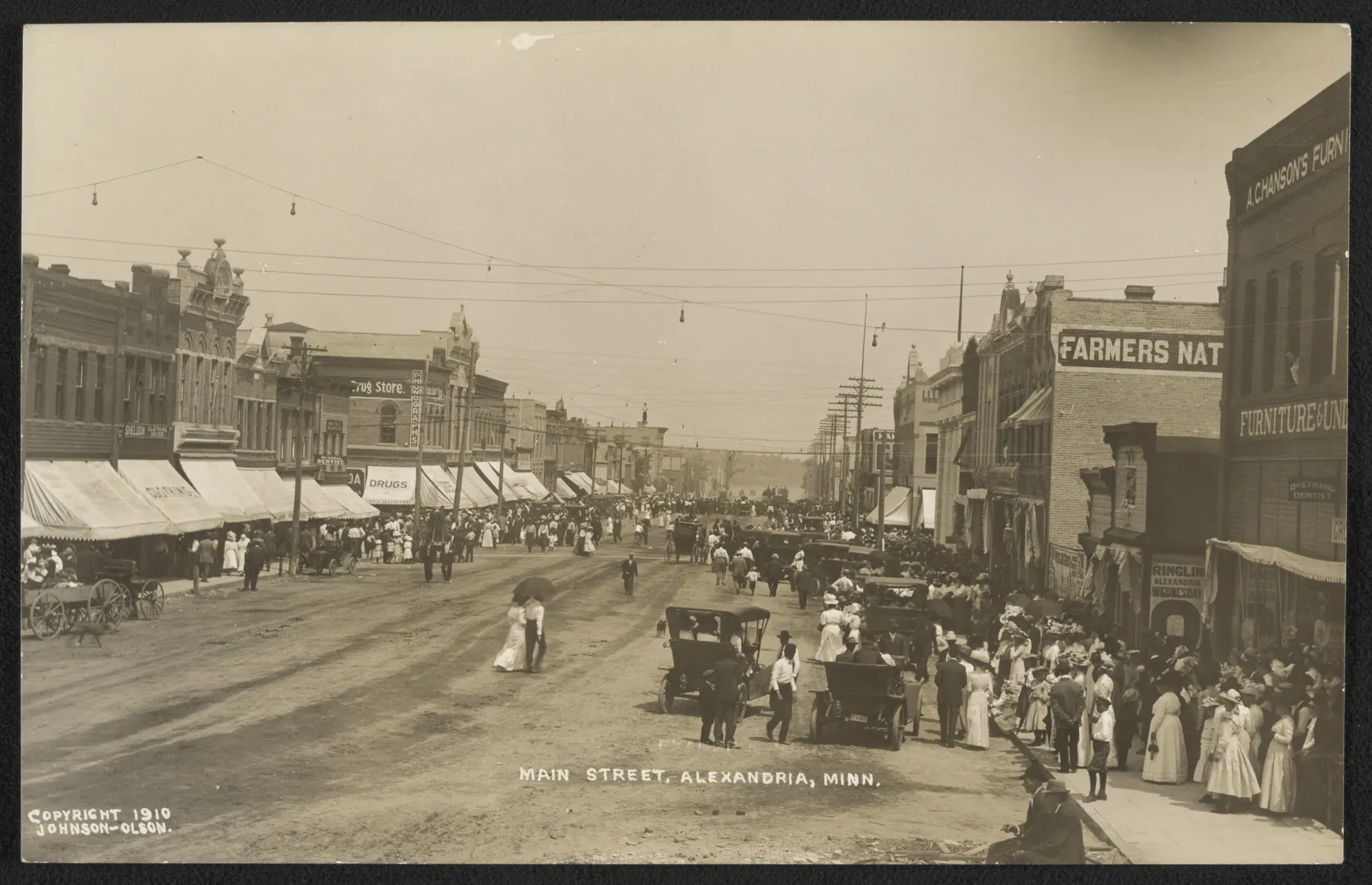
By 1916 the county history was already reading license plates from Oregon to Florida, and the automobile was quietly handing Lake Miltona to anyone who could pack a car and drive.
For its first four decades as a destination, Lake Miltona belonged to the railroad and to the men the railroad carried.
The first train, on the St. Paul, Minneapolis and Manitoba, the line that became part of the Great Northern system, reached Alexandria on November 5, 1878, and the club era followed it north. The Monmouth Club came first, then the Minnesouri Club in 1890, then the Chicago and Miltona clubs. These were private worlds. Members bought shore, built clubhouses and cottages, hired guides, and came back summer after summer. If you were not a member or a member's guest, the lake was something you looked at from a distance. The timetable decided when you arrived, the depot decided where your trip began, and the club gate decided how close to the water you got.
Then the visitors started arriving on rubber tires, and they did not need anyone's permission.
What the county history saw in 1916
The change came early enough that the 1916 county history recorded it as a settled fact. In its words: "The many attractive lakes throughout the county bring thousands of tourists into Douglas county during the summer season and most of these come in by automobile, the license plates of widely remote states being noted ... from Oregon to Florida and from New York to Texas."
Read that again. In 1916, while the club era was still in full swing, the county's own historians were already counting out-of-state plates at the lakes. The car did not ask for a membership. It did not run on the railroad's schedule. A family could load food, bedding, fishing tackle, and children into one vehicle, drive north on its own time, and stop at the lake that looked right. The trip stopped being an expedition arranged weeks ahead and became something closer to an impulse with luggage.
The First World War slowed everything down, and then the change the 1916 history had spotted became the pattern. The National Register nomination for Alexandria's historic district describes what happened next in plain language: "After automobiles became affordable for the middle class after World War I, resorts offering housekeeping cabins proliferated." The nomination names the Evergreen Inn on Lake Miltona among them.
What a housekeeping cabin was
A housekeeping cabin was a simple bargain, and it explains the whole era.
The resort supplied the shore, the cabin, a boat, and usually a main lodge. The guests did the rest. They cooked their own meals, kept their own cabin, and settled in for a week or more at a price a working family could manage. There was no dining room staff and no club steward. The lake was the entertainment, the dock was the schedule, and supper was whatever the day's fishing and the drive-in groceries produced.
It was less grand than a private club, and that was the point. The clubs had sold exclusivity. The cabin resorts sold access. Any family with a car and a week's wages could now hold a piece of Lake Miltona shoreline for seven days, and thousands of them did exactly what the 1916 history said they were doing.
The resorts the record names
The surviving record is honest about its limits, and so is this piece. The National Register nomination names the Evergreen Inn on Lake Miltona as one of the housekeeping-cabin resorts of the postwar wave. No source found gives the year the Evergreen Inn opened, and this piece will not guess at one. What the record does show is a resort that lasted. Echo Press obituaries trace it through local families: the Williams family bought the Evergreen Inn in 1946, when their daughter Audrie was a girl, and the Haugen family bought it a few years later, about 1949, when their son Harris was twelve. A postcard of its main lodge survives. Resorts that changed hands between lake families across those decades were not novelties. They were institutions of the car era, passed along like farms.
Ideal Beach enters the record through photographs. The Minnesota Historical Society holds two images dated 1925, one captioned "Scene at Ideal Beach on Lake Miltona" and one showing its main lodge. A main lodge and a working beach in dated photographs mean the resort was operating by 1925. Whether it opened in 1924 or years earlier, the research does not establish, and that gap stays a gap.
Beyond those two names, the nomination's word for the era is "proliferated," and the general run of small cabin resorts it describes is the story: a lodge, a row of plain cabins, a dock, and a family running the whole thing. The Lake Miltona versions mostly survive now as photographs, postcards, and names, which is why the named and dated evidence matters more than a long invented list would.
A private cottage from the same years shows what cabin life actually meant. The Chain Cottage went up on the lake in 1926, built by A. B. "Burt" Chain. Per the Echo Press account of its centennial, it started on stilts with no porch. One family kept it for a hundred years, and it waited until a 1960s update for running water and electricity. Nobody at the time thought that was roughing it. A cabin was a roof between the dock and the table, and the lake did the rest.
What the car changed for good
The train had made Lake Miltona famous among a narrow class of men. The car made it ordinary, in the best sense. It spread the lake across thousands of middle-class summers, one week and one cabin at a time, and it built the shoreline world the private lake homes would later inherit. The resorts of the car era are gone from the lake's working life, but the pattern they set, a family in its own small place by the water, is still the pattern of Lake Miltona today.
Visiting the story
- Lake Miltona's public accesses put you on the same 5,731 acres the car tourists drove so far to reach, plates from Oregon to Florida and New York to Texas.
- The Evergreen Inn and Ideal Beach survive in photographs and postcards held by the Minnesota Historical Society and local collections, and the Chain Cottage still stands in the family that built it a century ago.
- See it yourself: come the way they came, by car, and take the shore roads slowly. The lake they drove so far to reach is the same water, reached the same way.
Spot an error? Read our corrections policy.