Series: Best of 2027 Byline: Explore Miltona staff Updated: November 26, 2026
Forget dock talk. This ranking runs on Minnesota DNR survey nets only: walleye per gill net where a standard survey exists, muskie and panfish results where the DNR measured them, and lake size and depth from LakeFinder. Where a lake has no comparable standard survey rate, the entry says so and the lake drops, because a guess is not a ranking.
1. Lake Miltona
Best muskie water on this list, and the best all-around fishery.
Start with the walleye. The DNR's August 2023 standard survey caught 10.75 walleye per gill net, a rate the DNR scores above normal for similar lakes, with 138 fish measured from 7 to 27 inches and an average weight of 1.4 pounds. That is eater fish plus a real shot at one past 20 inches, in the same net pull.
Then the trophy program. The DNR manages Miltona first for walleye and muskellunge, stocked 1,381 muskie fingerlings in 2025, and has measured muskies to 50 inches in recent samples. Numbers stay low. That is the deal with muskies everywhere. You fish for one fish, and here that one fish can be a legitimate giant.
The supporting cast is not filler. Largemouth bass ran above normal in the 2023 survey, smallmouth measured to 18 inches, black crappie ran above normal at about three quarters of a pound on average, and northern pike came in below normal on numbers but above normal on size, averaging 3.1 pounds with the biggest at 32 inches. The DNR counts 19 species in all. The basin helps: 5,731 acres, a maximum depth of 105 ft, 15+ miles of shoreline, about half the lake less than 15 ft deep, and average Secchi clarity of about 10.7 ft.
Mary beats Miltona on walleye rate alone. Nothing else on this list beats it on walleye, muskie, species, and size combined.
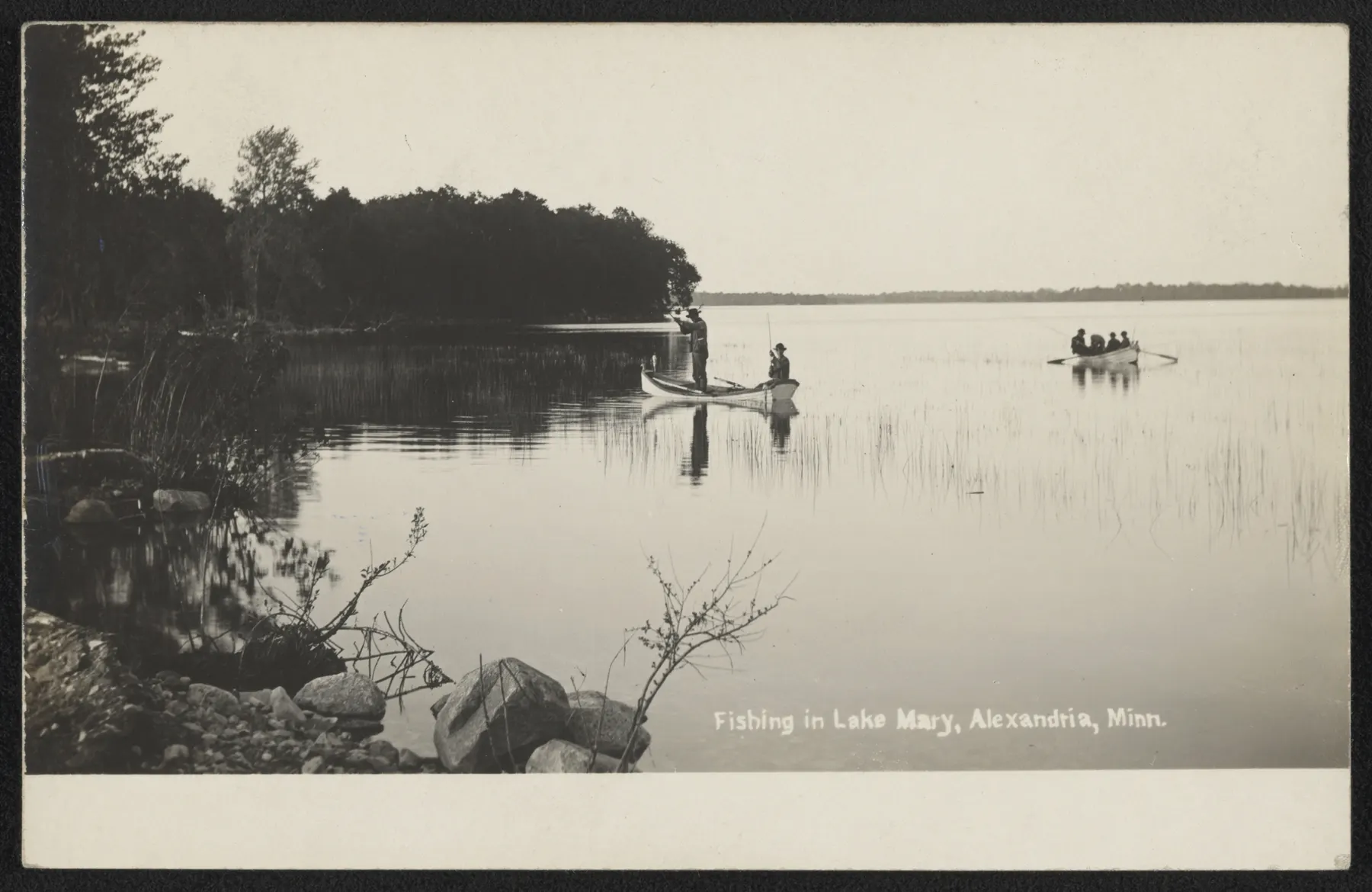
2. Lake Mary
Best walleye water on this list. It is not close.
The DNR's standard survey on August 11, 2025 caught 12.92 walleye per gill net. That is the highest standard survey walleye rate of any lake here, ahead of Miltona at 10.75 and Andrew at 11.42. If you keep one number from this whole page, keep that one.
The rest of the lake is more ordinary, which is why it is second and not first. LakeFinder records 2,450 acres, a maximum depth of 40 ft, a mean depth of 17 ft, and 11.7 miles of shoreline, five miles southwest of Alexandria. Secchi clarity in recent sampling runs 10.5 ft, and the 2025 survey text itself calls clarity moderate at 8 ft during that visit. The lake supports 17 documented species, with walleye, northern pike, largemouth bass, and bluegill listed as common.
Shallow, murkier, smaller. And the walleye nets do not care. Fish Mary for walleye first and everything else second.
3. Lake Andrew
The small lake that out-fished almost everybody.
Andrew is 923 acres. That is it. The DNR's standard survey on June 25, 2024 still caught 11.42 walleye per gill net, the second highest rate on this list. Lakes six times its size wish their nets looked like that.
Depth does the work. LakeFinder records a maximum depth of 83 ft, a mean depth of 29 ft, and 5.6 miles of shoreline south of Alexandria, with recent Secchi sampling at 13.9 ft. Deep, clear, compact. You can learn Andrew in a weekend in a way you will never learn Osakis, and the walleye rate says the learning pays.
Andrew has no muskie story and no panfish headline in the sourced record we have. It does not need one. This is a walleye ranking spot, earned in the nets.
4. Lake Ida
The deep, clear all-rounder with a muskie in it.
The DNR's standard survey on August 7, 2023 caught 7.33 walleye per gill net. Fourth best standard rate here, and it comes with the best supporting numbers of any lake below the top three: 4,445 acres, a maximum depth of 106 ft, a mean depth of 28 ft, 22.6 miles of shoreline, and Secchi clarity of 16.4 ft in recent sampling.
The DNR counts 19 species on Ida, including muskellunge, smallmouth bass, largemouth bass, northern pike, and tullibee (cisco). Read that muskie line carefully. Ida has muskies on the species list. It has no sourced stocking count or 50 inch sample figure in the record we have, which is why the best muskie call belongs to Miltona and not here. What Ida does have is four public landings and a walleye rate that holds up.
If Miltona did not exist, Ida would be the argument. It does, so Ida is fourth.
5. Lake Geneva
Pound for pound, the chain lake that punches up.
Geneva is the small end of the Alexandria Chain, 640 acres on the eastern edge of Alexandria with a navigable connection to Le Homme Dieu. The DNR's standard survey on August 5, 2024 caught 4.33 walleye per gill net, a better rate than the two chain lakes ranked below it, and counted 17 documented species, including walleye, largemouth and smallmouth bass, northern pike, and bluegill.
LakeFinder records a maximum depth of 63 ft, a mean depth of 24 ft, and 5.2 miles of shoreline. Recent Secchi sampling runs 14.1 ft. Deep for its size, clear, and easy to fish without a big boat or a big plan.
Geneva ranks fifth on rate and fifth on little else. Sometimes the nets are the whole story.
6. Lake Le Homme Dieu
Twenty species, one modest walleye rate.
The DNR's standard survey on August 12, 2024 caught 3.50 walleye per gill net and counted 20 documented species, the second highest species count on this list. Walleye, largemouth and smallmouth bass, northern pike, bluegill, black crappie, and tullibee (cisco) are all on the record. If variety is your game, this is your lake.
The physical numbers are solid too: 1,801 acres, a maximum depth of 85 ft, a mean depth of 19 ft, 10.1 miles of shoreline on the northeast edge of Alexandria, recent Secchi sampling at 13.1 ft, and navigable connections to Lake Carlos and Lake Geneva. You can fish three lakes without loading the boat.
The walleye rate is the ceiling. At 3.50 per gill net, Le Homme Dieu is a fish everything lake, not a walleye destination. Ranked honestly, that is sixth.
7. Lake Darling
Good lake, quiet nets.
Darling opens the Alexandria Chain on the northwest edge of the city: 1,050 acres, a maximum depth of 62 ft, 6.8 miles of shoreline, and recent Secchi sampling at 14 ft, clearer than several lakes ranked above it.
Then the survey. The DNR's standard survey on July 15, 2024 caught 2.25 walleye per gill net, the lowest standard survey walleye rate among the chain lakes here. That is the whole reason for seventh. Size, depth, and clarity all say Darling should sit higher. The fish the DNR actually caught say otherwise, and this list follows the fish.
8. Lake Moses
Best panfish water on this list, and the pike are not a consolation prize.
Read the walleye line first so nobody accuses this entry of hiding it. In the standardized DNR survey completed June 13 to 16, 2022, walleye abundance on Moses fell to a record low 1.5 fish per gill net, despite years of stocking fingerlings, yearlings, and adults. The fish that were caught ran 11 to 24 inches and averaged 17 inches. Nice fish. Just not many of them.
Now the reason Moses is on this list at all. The same survey calls panfishing opportunities excellent. Bluegill abundance is high, nearly 34 percent of the bluegill caught in trap nets were over 8 inches, and several 10 inch bluegill were observed, with fish sampled up to age 12. Black crappie catch rates were moderate and near the long term average, 26 percent of the crappie were over 10 inches, and the largest observed was 13 inches. Northern pike catch rates sat near the long term average with abundance still considered high, many pike over 30 inches were observed, and the largest was 37 inches. Largemouth bass remain abundant on the June electrofishing work, running 8 to 17 inches.
The lake itself is an 822 acre basin about a mile west of Millerville in northwest Douglas County, with an average depth of about 16 ft and a maximum depth of 32 ft, and water transparency measured at 24 ft at the time of the June 2022 survey. Shallow, weedy, clear, and built for panfish and pike. Fish it for what the survey says it is.
9. Lake Carlos
The deepest, clearest lake here, ranked on a survey record too thin to trust higher.
Carlos has the most impressive physical numbers on this page: 2,605 acres, a maximum depth of 163 ft, a mean depth of 50 ft, 12.8 miles of shoreline, Secchi clarity at 18 ft in recent sampling, and 21 documented species, the highest count here, including walleye, northern pike, largemouth and smallmouth bass, bluegill, black crappie, and tullibee (cisco).
So why ninth? Because the most recent DNR work we could verify is a targeted survey on August 20, 2024, which caught walleye at 0.42 per hour of electrofishing. That is a nearshore targeted method. It does not compare with a standard gill net rate, and this list does not pretend it does. Carlos may well fish better than ninth. The sourced standard survey evidence to prove it was not available to us, and inventing a rate to move it up would be lying with numbers.
When a fresh standard survey posts, Carlos is the first ranking here that should move.
10. Lake Osakis
The biggest water here, with the murkiest paper trail.
Osakis is 6,389 acres across Douglas and Todd counties, with a maximum depth of 73 ft and a mean depth of 20 ft on the DNR LakeFinder record. Size alone gets it on any area list.
The fishing evidence we could source is qualitative, not a rate. The DNR Glenwood Area Fisheries Outlook for 2026 to 2027 groups Osakis with the area lakes holding good walleye numbers, and lists it among the lakes sampled in 2026 with fishable smallmouth bass populations. Good signs. Neither one is a standard survey walleye rate, and we verified no clean recent rate or Secchi figure for Osakis in this pass.
Tenth is a data ranking, not an insult to a 6,389 acre lake. Check Osakis on LakeFinder first before a 2027 trip, because its entry is the one most likely to change.
11. Lake Irene
Miltona's quiet neighbor, last on evidence, not on evenings.
Irene sits west of Miltona, connected to it by Boggy Creek: 639 acres, a maximum depth of 44 ft, a mean depth of about 20 ft, and 4.2 miles of shoreline. Recent Secchi sampling runs 9.8 ft, the lowest clarity figure on this list.
The recent survey work we could verify is a targeted survey on August 3, 2022, which caught walleye at 0.09 per trap net. Like the Carlos electrofishing figure, that is a targeted nearshore method and does not compare with the standard gill net rates above it. No recent standard survey rate for Irene was available to us, so no standard rate appears here.
That thin record puts Irene eleventh. Locals who fish it on a calm weeknight will tell you the ranking is wrong. They might be right. The DNR paper we could check does not prove it yet.
The short version
Walleye: Mary, then Andrew, then Miltona. Muskie: Miltona, and it is the only sourced trophy program here. Panfish: Moses, by a mile, with Miltona's above normal crappie as the runner up story. Everything at once: Miltona. That is why it leads a fishing list even though Mary owns the single best walleye number on the page.
Corrections: Explore Miltona corrects lake figures against MN DNR LakeFinder. Send a correction with the LakeFinder lake name and survey date.
Spot an error? Read our corrections policy.