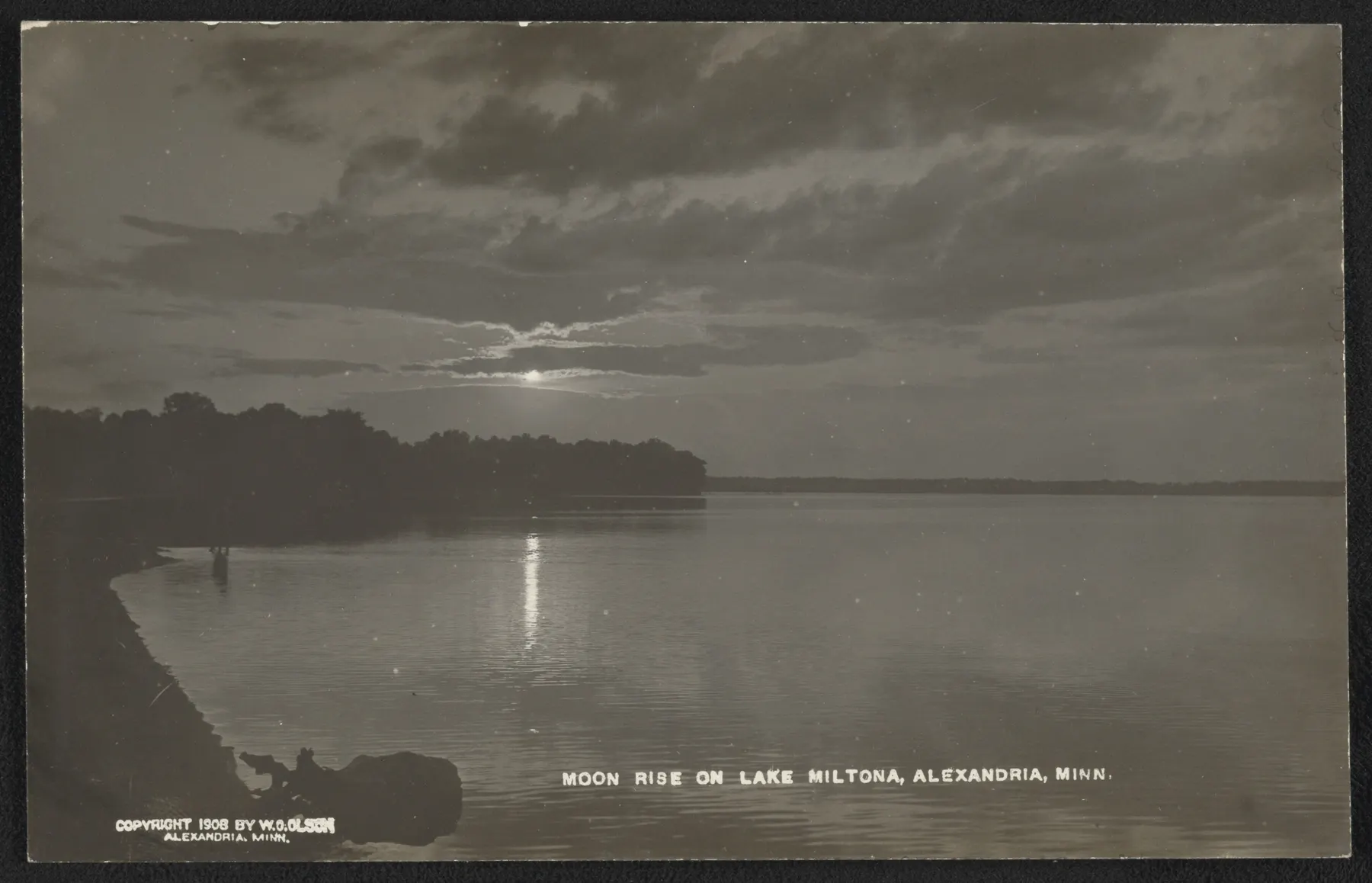
Every lake up here has a name. This one carries a pioneer's wife, and she did her family washing on its shore.
Start with the woman, not the name. Florence Miltona Roadruck stood on the shore of the biggest lake in Douglas County with her family's washing in her hands. The 1919 account of her life here, printed in the Alexandria Post News, Alexandria's hometown paper of the day, kept that one small human detail from her years on this water: "Tradition tells that the family washing of the Roadrucks was often done on the lake shore." Before the resorts, before the fishing clubs and the bass tournaments and the docks running out into the sunset, this lake was somebody's wash water. A woman hauled laundry down to the shore of 5,731 acres of cold, clear water and did the week's work. Her name ended up on all of it.
The Roadrucks
Florence came west with her husband, Benjamin Franklin Roadruck. In 1866 or 1867, the couple came out from Indiana and took a homestead in Section 22 of Leaf Valley Township, at the west end of the big lake. This was raw country. Douglas County had only been organized in 1866, the year the soldiers left Fort Alexandria and settlers came back after the U.S.-Dakota War emptied the county four years earlier. The Roadrucks were among the first to try farming the west shore.
They were not passing through. They put down the kind of roots that start institutions. On November 13, 1872, the First Methodist Episcopal church of Parkers Prairie was organized at Benjamin Roadruck's house in Leaf Valley. A congregation's first meeting, held in the homestead of the man whose wife would name the lake.
Florence's middle name was Miltona. The lake took it. The township took it from the lake, and decades later the town took it from the lake too. Warren Upham's 1920 Minnesota Geographic Names, the state historical society's book on where Minnesota place names came from, dates that step: Miltona Township was established on December 19, 1871, receiving its name from the large Lake Miltona, which occupies more than a sixth part of its area. That is the whole mechanism, and it is documented: Miltona Township's own history page states flatly that Lake Miltona was named for Mrs. Florence Miltona Roadruck, wife of Benjamin Franklin Roadruck, and that the family homesteaded in Section 22 of Leaf Valley Township. What no record found for this story says is who first proposed her name for the lake, or why it was chosen. No naming vote, no ceremony, and no stated reason survives in the sources. The record gives the honor. It does not give the conversation behind it. Say the name out loud and it sounds like a place that was always called that. It rolls like it grew out of the water. It did not. It came west with a family from Indiana, and it stayed on the map long after she went home.
Her daughter got a lake too
The Roadrucks had a daughter named Irene. The smaller lake just north of Miltona was originally called Reservoir Lake, a name with no poetry in it at all. One honest wrinkle: Upham's 1920 book calls that earlier name Reservation Lake, and the Lake Irene association's history notes that some sources give it that way, so the old name itself comes down in two forms. Either way, it was renamed for Irene Roadruck. So the mother got the biggest lake in Douglas County, and the daughter got the quiet one up the road. Both names are still on the map. Both women have been gone for more than a century.
Irene matters to this story twice over, because she is also the reason anyone knows it. Hold her in mind for a moment. She comes back at the end, from about as far away as a person could get.
Ten years, then Indiana
Here is the part that keeps the story honest. The Roadrucks did not stay. In 1877, about ten years after they arrived, they sold the homestead and returned to Indiana. Frontier farming at the west end of a Minnesota lake was hard, cold work, and plenty of homesteaders made the same call. Florence Miltona Roadruck left Minnesota with her name still on the water.
She never came back to claim it. The name just kept working without her. Settlers platted a townsite and called it Miltona. The Soo Line, the railroad that built through Douglas County in the early 1900s, put in a station there, with a depot built in 1912. The town incorporated in 1930. Generations of kids learned to swim in Florence's middle name without ever hearing hers.
A letter from Alaska
For decades, apparently, nobody had the story written down straight. It took until 1919, and it took Irene.
On October 2, 1919, the Alexandria Post News printed the naming story, and it credited its sources the way a good paper should. George L. Treat of Alexandria had examined the county records and confirmed the name honored Florence Miltona Roadruck. The information itself came in a letter from Irene Roadruck, writing from Fairbanks, Alaska. The daughter who had a lake of her own was the one who set down, for the record, how her mother named a lake, and her letter is where the washing on the shore survives. The family's own voice, carried home in an envelope.
Think about the geography of that letter. A woman in Fairbanks writes to Minnesota about a homestead her family left forty years earlier, so that a name on a map gets its story back. It worked. The Douglas County Historical Society still carries the account, and the township page repeats it to this day.
The legend
There is a second story about where the name came from, and it has no paper behind it at all. The City of Miltona's own history page will tell you the lake was "said to be named for a Sioux Chief, meaning 'blue waters.'" It is a pretty story. It is also, as far as anyone can document, just a story. No chief is ever named. No record backs it. The township's own history page tells the Roadruck story, and the county records back that one up. Legends like the blue waters version stick around because they sound like what people want a lake name to mean. This one you can let go of. The true story is better anyway.
Saying her name
Stand on the shore at the end of a summer day, when the light goes long and gold and the whole lake flattens out, and you are standing in a place named for a woman who did laundry here. Not a chief. Not a railroad man, not a land speculator, not a senator. A homesteader's wife who lasted ten winters' worth of trying and then went home to Indiana, leaving the best thing she had on the map.
Every boat that launches, every kid who cannonballs off a dock, every fisherman who says "Miltona's been good to me" is saying her name. Florence Miltona Roadruck. It is about time the lake's visitors knew it.
If you go
Lake Miltona is the largest lake in Douglas County at 5,731 acres (Minnesota DNR), and the town of Miltona sits at its west end, where the Roadruck homestead was. Lake Irene, Irene's lake, is just north. The township history page at miltonatownship.org tells the naming story in its own words, and the Douglas County Historical Society in Alexandria holds the deeper record.
Spot an error? Read our corrections policy.