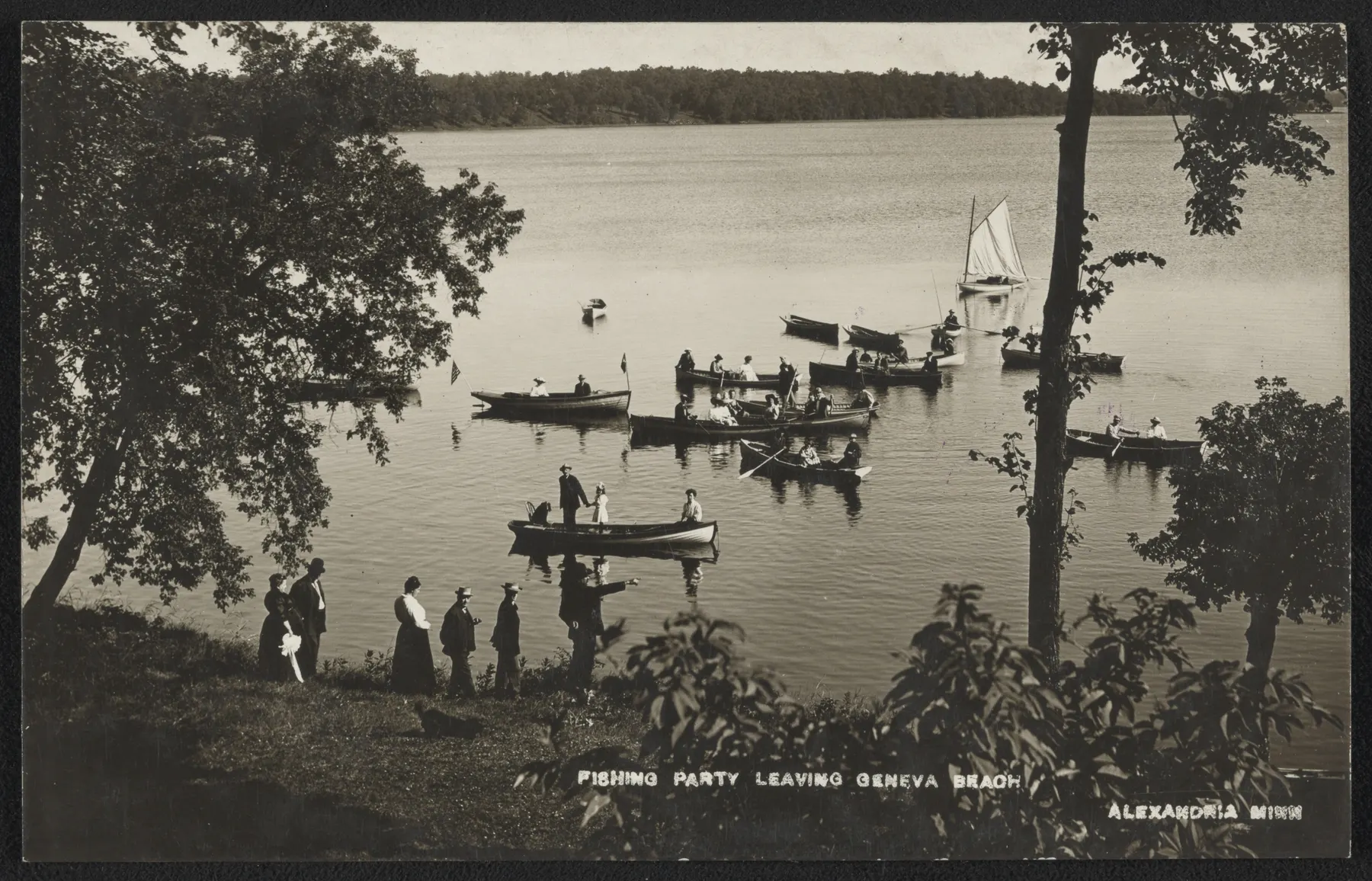
For four summers in the 1890s, fifteen men from Illinois wrote down every fish they caught, and the notebook outlived them all.
Most fishing stories get bigger every time they are told. This one got written down.
In the 1890s, before the big club on Lake Miltona had finished making its name, another club was already there. The Monmouth Club came before the Minnesouri, and its members came from Monmouth, Illinois. They were summer men, riding north to Douglas County for the same reason everybody else did: the bass fishing was the best they had ever seen, and the summers back home were hot.
What makes the Monmouth men different from every other club that fished this lake is not that they caught fish. It is that they kept the receipts.
A record of every trip
From 1894 to 1897, the club kept a fishing log. Its title, written out in full, is "Records of Fishing Success by Members of the Monmouth Miltona Club, 1894 to 1897." Fifteen members. Four seasons. And, by the account of the scientist who later studied it, a record of every trip.
Think about what that took. These were vacationers, not clerks. Nobody made them do paperwork. But after a day on the water, somebody sat down and entered the trip in the book: the fishing, trip after trip, summer after summer, on Lake Miltona and on nearby Lake Ida and Spring Lake. The log was part bragging book and part club memory, the kind of thing men keep so that next winter, back in Illinois, the arguments about who caught what could be settled by turning a page.
The fish at the center of it were bass. When the log was studied decades later, the scientist's judgment was plain: the club's 15 members "were, evidently, expert fishermen who preferred to catch largemouth and smallmouth bass." That preference was the whole era in one sentence. This was the Bass Kingdom, the title the Minnesouri and Illinois fishing clubs gave Lake Miltona, and the Monmouth log is what the kingdom looked like written down day by day.
The notebook becomes evidence
Here is where the story turns. Clubs fade. Members die. Cottages change hands. Paper usually goes to a fire or a dump. This notebook went to an archive.
The log survives today at the Minnesota Historical Society in St. Paul. And in the 1950s, it stopped being a souvenir and became something nobody in 1894 could have predicted: scientific evidence.
John B. Moyle, a Minnesota fisheries scientist, carried the log in the state fisheries reports in 1954. In 1955 he built on it in a paper called "Sport-Fishing Trends in Minnesota," published in The Progressive Fish-Culturist. Moyle had a problem every fisheries scientist of his generation had. He was trying to understand what Minnesota's lakes held and how sport fishing had changed, but the lakes had been fished hard for sixty years before anybody thought to measure them. There was no baseline. There were no creel surveys from 1895.
Except, on three lakes in Douglas County, there was a baseline. Fifteen Illinois men had written it without knowing, one trip at a time.
That is the strange afterlife of the Monmouth log. A vacation club's bragging book, kept for winter arguments, turned into one of the few hard records of what these lakes produced before modern fish management existed. The men in the boats thought they were keeping score. They were keeping history.
What the log cannot tell you
Honesty matters here, because the log invites romance and the record is thinner than the romance.
No list of the club's founders survives in print, and this piece is not going to name any. The members stay mostly anonymous, fifteen men identified by their handwriting and their summers. The log records success, which is what its title promises; a club does not keep a book of the days the fish won. And the Monmouth name itself is nearly all that is left of the club. It was older than the famous club next door, and it is the famous one that got remembered. The Monmouth men got the archive instead.
There is a fairness in that, if you look at it right. The Minnesouri Club kept its porch, its cottages, and its name on the road. The Monmouth Club kept the numbers.
Reading it now
The log still sits at the Minnesota Historical Society, which means the most durable thing any fisherman ever made on Lake Miltona is not a trophy or a photograph. It is a notebook in a box in St. Paul, waiting for the next person patient enough to read four summers of bass fishing line by line.
The lake those men fished is still here, all 5,731 acres of it, and it is public now, in a way the men who kept the log would not have pictured. The bass are still here too, largemouth and smallmouth both, working the same kind of water the Monmouth men rowed out to in the mornings. You do not need a membership to fish it. You need a license, a boat or a dock, and a summer evening.
If you go, consider keeping a log. Not for science, though science may come calling in sixty years. Keep it because four summers of honest writing once outlasted a kingdom, and yours might too.
See it yourself
- The Monmouth Club's fishing log, "Records of Fishing Success by Members of the Monmouth Miltona Club, 1894 to 1897," is held by the Minnesota Historical Society in St. Paul.
- John B. Moyle's paper built on the log is "Sport-Fishing Trends in Minnesota," The Progressive Fish-Culturist, 1955.
- Lake Miltona's public accesses put you on the same water the Monmouth men fished, no club required.
Spot an error? Read our corrections policy.