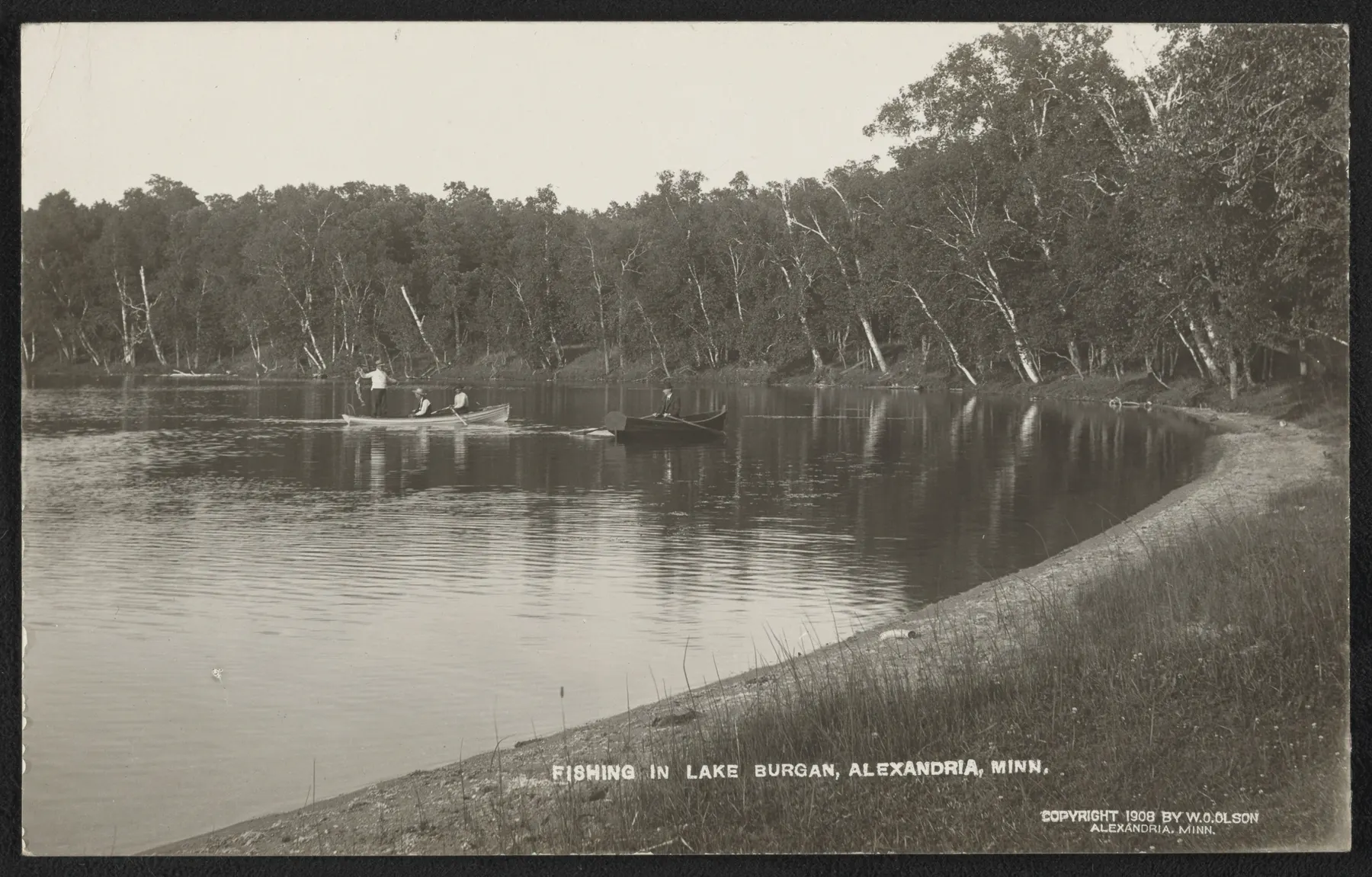
In the 1880s, men rode the train north for one reason: the bass in Lake Miltona were worth the trip.
In the 1880s, a group of Minnesota businessmen who had fallen for this lake started bringing their friends up from Kansas City, Missouri, to fish it. Before there were resorts on Lake Miltona, there were invitations. That is the whole origin story, and it is a good one. No developer, no brochure. Just men who had caught bass here telling men who had not: you need to see this water.
The trips turned into something permanent. In 1890 the visitors and their hosts bought 40 acres on Lake Miltona and drafted articles of incorporation for a club. Twenty of the founding members were from Missouri and fifteen were from Minneapolis, according to the Legacy of the Lakes Museum in Alexandria. They named the club by blending the two home states together: Minnesouri.
The name is a little clumsy. The idea behind it was not. Their charter said the club's purpose was "the instruction and mutual improvement in the art of angling and the social culture and entertainment of its members." Strip the formal language and it says what every fishing camp still says. Get better at this. Enjoy each other. Come back next summer.
And it was not a shirt-sleeves camp, at least not at supper. Kori, commenting on a Douglas County Historical Society post in August 2023, sang and played keyboards at the Minnesouri dinner hour and remembers the adults in formal black-and-white dining attire. Men who spent the day in a boat over bass sat down to dinner dressed for it.
A kingdom, by acclamation
The Minnesouri men were not shy about the lake they had claimed. The City of Miltona's own history records that the Minnesouri and Illinois Fishing Clubs dubbed Lake Miltona "the Bass Kingdom of the United States."
That was a bold title in the 1890s, and the men who handed it out had fished enough water to know what they were claiming. Bass were the fish here then. Lake Miltona's walleye fame came later. In the club era, a good evening meant largemouth and smallmouth bass working the shallows as the light went down, and a stringer heavy enough to brag about at supper.
The Minnesouri was not even the first club on the lake. The Douglas County Historical Society records that the Monmouth Club came before it. And the Minnesouri was not the only one for long. An 1894 listing in the Alexandria Post News, Alexandria's newspaper of record for the era, names "The Chicago Club, The Minnesouri Club, and At the Arlington" among the early resort clubs. A Miltona Club, started by men from Illinois, belonged to the same era. Its leader for a time, a Colonel VanCleave of Springfield, Illinois, pushed a scheme to open channels from Lake Miltona up into the chain of lakes around Alexandria, so people could do their shopping by boat instead of by horse-drawn wagon. The channels never happened. The ambition tells you how seriously these men took their lake. A Minnesota Angling Club rounds out the names the historical society preserves from the period, though almost nothing else about it survives in print.
Who exactly were the 35 men who signed the Minnesouri into being in 1890? Plain answer: their names are not published anywhere online. The articles of incorporation sit in county records, and the historical society holds the deep files. Until somebody pulls them, the founders stay anonymous, which is a strange fate for men who named a kingdom.
The catch log
One club's paperwork did survive, and it turned out to be science.
The Monmouth-Miltona Fishing Club kept a catch log from 1894 to 1897. Fifteen members, fishing mostly on Miltona, Ida, and Spring Lake, wrote down what they caught. The historical notes describe them as expert fishermen who preferred to catch largemouth and smallmouth bass.
Sixty years later, fisheries scientists went looking for old records of what these lakes held before modern management, and the club's log was still there to be used. Fisheries scientist John B. Moyle built on it in "Sport-Fishing Trends in Minnesota," published in The Progressive Fish-Culturist in 1955. Think about that. A vacation club's bragging book, kept in pencil in the 1890s, ended up as data in a scientific journal. The men writing down their bass were, without knowing it, keeping the lake's memory.
The men who stayed
The club members came and went with the summers. The local men stayed, and two of them gave the club their whole working lives.
Herman Engfer, born in Carlos Township in 1880, was the caretaker of the Minnesouri Angling Club for 56 years. His daughter Madeline grew up at the club, where her father also worked as a fishing guide. Alfred Schulke, born in 1899, spent 59 years employed by the club as a fishing guide. Fifty-nine years of putting other men's boats on fish, through the club era, two world wars, and everything after.
The work was not all boats and tackle. Cheryl, commenting on a Douglas County Historical Society post in July 2026, remembers her grandfather Gene Hagedorn guiding at the Minnesouri while her grandmother Lydia worked there as a housekeeper. After the fishing, he cleaned the clients' catch and cooked it for them over an open fire, in a frying pan big enough that the family kept it, and keeps it still.
Families came back the same way. Published obituaries from recent years describe Kansas City families whose cottages have been in the family for more than 100 years, and members now into the fourth and fifth generations. One man met his wife at the club when both were 15. Gregg, commenting on a Douglas County Historical Society post in August 2023, put the membership rule in one line: "You had to be born into that club." That is what a fishing club becomes if it lasts long enough. It stops being a club. It becomes the place a family is from, one summer at a time.
What is left
The Minnesouri Club is still there, and it is still private. The clubhouse dates to 1890, the cottages are a century old, and the club operates today as the Minnesouri Association of Cottages. It is not open to the public, and this piece is not an invitation to drive down its road.
The public way into this story is in Alexandria, at the Legacy of the Lakes Museum, which has re-created a Minnesouri Club front porch as an exhibit. You can stand on the porch, look at the lake life of 1890, and get the feel of it without trespassing on anybody's summer.
And the lake itself is public, all 5,731 acres of it. The bass are still here. So are the walleye and the muskies that made the lake famous in later chapters. Every evening in June, when the light goes long and gold and somebody casts toward a weedline, the kingdom is still in session. It just belongs to everybody now.
See it yourself
- The Minnesouri Club is members-only, and its shore reads best from a boat.
- The closest a nonmember gets to the clubhouse is the re-created Minnesouri front porch at the Legacy of the Lakes Museum in Alexandria.
- Lake Miltona's public accesses put you on the same water the clubs fished.
Spot an error? Read our corrections policy.