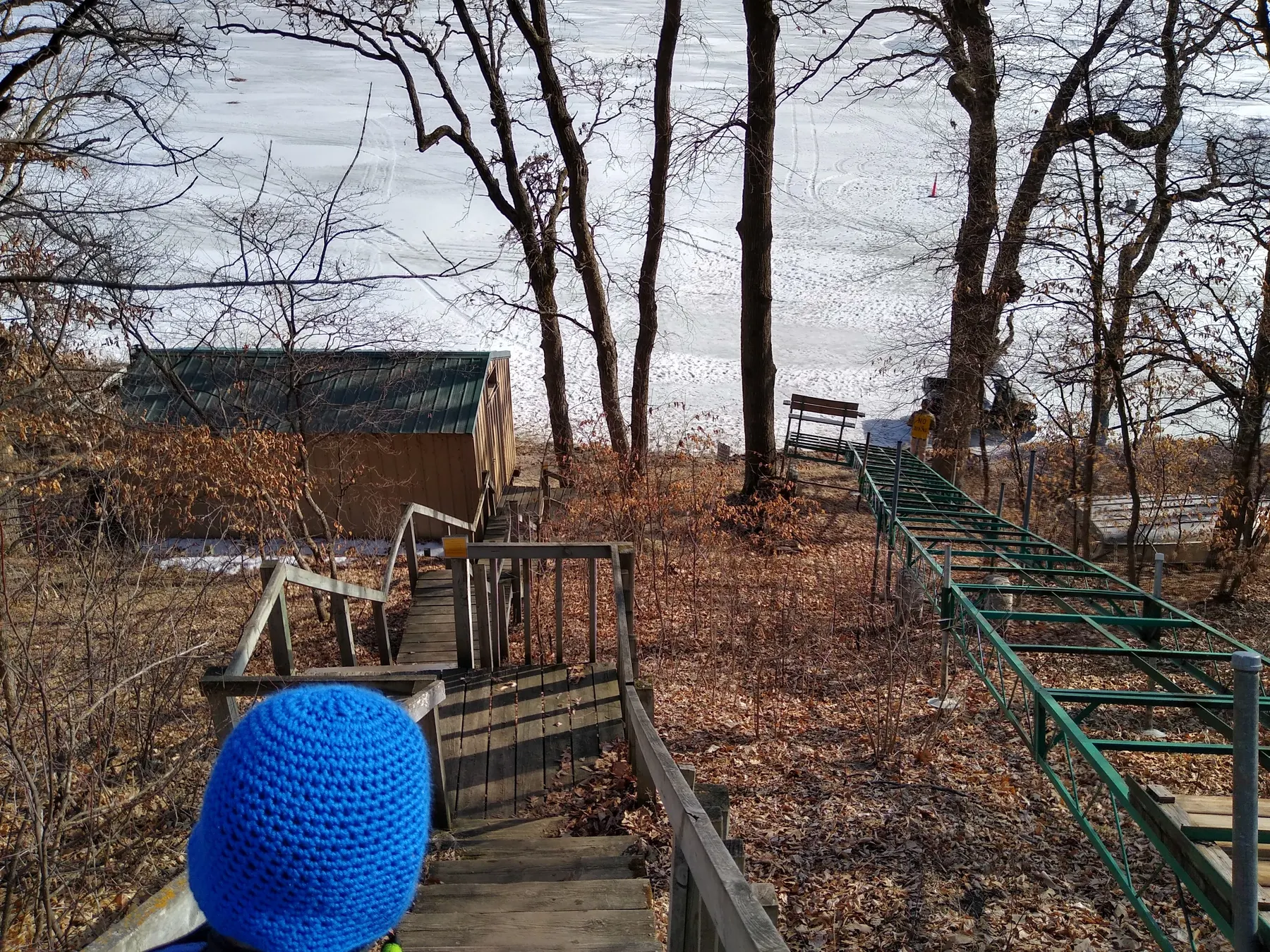
Twenty-one acres of woods on Lake Miltona's north shore, with 550 feet of sandy beach a farm couple gave away in 1958 so kids could keep camping here.
In 1958, William and Minnie Schultz, a local farm couple, gave away 21 acres of mature forest and 550 feet of natural shoreline on Lake Miltona so that Girl Scouts could camp in these woods. The camp that gift created still runs on the gift's terms, and the first thing to understand about it is this: you cannot book it by yourself. Smokey Timbers spreads 21.3 wooded acres along that same north shore shoreline, and the gate opens for groups or not at all. Scout troops, 4-H clubs, school groups, church groups, and big families are the customer. A lone tent looking for a quiet weekend is not. The camp exists because the Girl Scout council tried to sell this shoreline for development in 2003 and the neighborhood refused. Volunteers bought it, paid off a $150,000 mortgage, and run it today as a nonprofit. No staff empire, no individual campsites, no Wi-Fi. Bring a crew or do not come.
The Local's Guide
- What people love: The beach and the boats. The camp holds 550 feet of sandy shoreline with a shallow, sandy-bottom swimming area that works for little kids, and the boathouse fleet comes with the rental: canoes, kayaks, paddleboards, paddleboats, lifejackets, and aluminum boats. Groups also love booking the whole woods instead of one site in a row of strangers. The Lake Miltona Association's minutes record more than 1,800 visitors in a year here and a record number of reservations, so the love is measurable. The campers who write it up keep it short. "Great place for a large family to relax and enjoy the outdoors," one wrote (Teresa V., Google, July 2018). Another: "Far exceeded expectations!" (Jesse N., Google, June 2019).
- The local favorite: The October doubleheader. The camp runs its Trail of Treats hike for young kids in the afternoon and a Spooky Hike through the dark trails at night, and it is the one stretch of the year when the trails open to anyone who registers.
- What to book: Book the Main Camp. It includes the bunkhouse, the screen porch and deck, the kitchen building, the large yurt, the lakeshore, and every campsite, and the restroom building comes with all rentals. Camper spots and the small yurt exist only as add-ons to a Main Camp rental. Bring tents, sleeping bags, and your group's food. The kitchen is stocked for group cooking, and the boats and lifejackets are already on site.
- When to go: Summer for the mini-camps, FIKA on Wednesday mornings at 10 in the summer, the July Water Camp, and the August fish fry, October for the Halloween trails, and winter if your group is hearty, because the yurts carry fireplaces and the winter rates drop hard. Prime summer weekends go early. The cheap door in is a weekday: day rates run Monday through Thursday, 8 a.m. to 8 p.m.
- Insider tip: OWNER TIP: the foundation itself recommends tents over campers for the best experience. Leave the rig at home and pitch in the trees the way the place was built for.
- Heads up: Groups only. There are no individual campsites and no solo bookings, and camper spots and the small yurt exist only as add-ons to a Main Camp rental.
A Girl Scout camp the lake refused to lose
One spelling note that matters around this lake: the donors' name is Schultz, with a t, not the Schulze family that turns up in the lake association's donor talk. Different name, different people. The Schultzes gave the land to stay an environmental and recreational place forever, and for a long time it did exactly that.
Girl Scouts ran the camp for 45 years. Ownership eventually passed to the regional council, local connections faded, and use declined. In 2003 the council decided to sell, and commercial development on the shoreline looked inevitable. Miltona area residents, permanent and seasonal, organized the rescue. With coordination from the WesMin Resource Conservation and Development Council, they bought the camp in 2004. A volunteer board took over operations, an independent Smokey Timbers Foundation formed, earned its 501(c)(3) status, and took ownership in 2009 under a transfer agreement protecting it as a natural resource. Members of the Schultz family sat on that early foundation board, wanting the land's purpose to stay what it was in 1958.
The foundation also took on the camp's $150,000 debt, and it inherited a tired plant. Foundation president Cheryl Penkivech described the starting point in the Echo Press: "We had the bunkhouse, the kitchen building and the screen porch. We had no indoor plumbing. We had water, and outhouses were the only facilities to be used, and we had an old shower house." The mortgage was retired in 2018, and the upgrades since then are the camp you see now: indoor plumbing, a multi-room restroom and shower building, an outdoor kitchen, the yurts, and a new patio where a deck used to be.
Who runs it now
Volunteers run it, all of them. The Smokey Timbers Foundation is a 501(c)(3) nonprofit with an all-volunteer board of directors, and Penkivech serves as its president. Her standard for the place is use, not preservation under glass: "I like the fact that people are using it. It's not sitting here, rotting away." Camper fees fund the operations, and donations fund the special projects, according to the camp's own report to the Lake Miltona Association, which donates $2,500 a year to the camp.
The help is local and specific. Law enforcement students from Alexandria Technical and Community College do grounds work at the camp, and the Thin Blue Line Trail on site is dedicated to law enforcement graduates who died in the line of duty. The Douglas County Soil and Water Conservation District named the foundation its outstanding conservationists in 2017, after the camp installed a water and sediment control basin, diversions, and an underground outlet to stop a gully from eroding into Lake Miltona. The Miltona Lions Club is a donor and a regular: it supplied a camper cabin on the grounds and holds its steak fries under the camp pavilion. And the phones stay put away. "We don't have Wi-Fi here, intentionally," Penkivech said. "Put your stuff away, come out and just have some outdoor-based fun."
The grounds: what your group actually gets
The screen house is the hub, a screened gathering space with a stone wood fireplace, the new patio beside it, and a block concrete storm shelter underneath. The kitchen building stands next door, stocked for group cooking. The bath and shower house sits a short walk away.
Sleeping covers every comfort level in a group. The bunkhouse sleeps 8 to 10 and carries its own kitchen, bathroom, and a deck facing the lake, though its running water shuts off in winter. The large yurt, built for summer and winter use with a gas fireplace, hosts meetings, retreats, reunions, and bridal showers. The small yurt is solar powered, heated by a wood stove, and sits at the end of a hike in the trees, so pack light and mean it. A camper cabin the Miltona Lions Club stocked bunks another 8 to 10. The campsites tuck into the trees with water, picnic tables, and fire pits, four of them with shelters, named Owl's Nest, Oak Ridge, and Big Open. Trails, a slingshot range, and a playground fill the hours between swims.
One blunt note about the water: the shoreline shelves out shallow, which makes the dock a poor fishing spot and a perfect wading beach for small kids. Fish from a boat instead. The lake gives you room: Lake Miltona covers 5,731 acres and holds muskies, a real target for the serious angler in your group.
The calendar and what it costs
Summer brings a dozen mini-camps teaching sourdough and cookie baking, crafts, chainsaw safety, and fishing, kept cheap by sponsors. The camp hosts a two-day Water Camp with the Legacy of the Lakes Museum each July. The museum is Alexandria's lake-life museum, opened in 2004, and it preserves the world this camp belongs to: classic wooden boats, fishing history, and the grand resorts of the early lake era. A camp saved by its neighbors pairing with the museum that keeps the lake's memory is a natural fit, and the kids get both halves of it, the artifacts and the water. October closes the public season with the Trail of Treats and the Spooky Hike. A winter activities event lands in February or March, and weddings, reunions, holiday parties, and club gatherings fill the rest.
Rates are published on the camp's own site, checked November 2026, and they are nonprofit rates, not resort rates. The Main Camp runs $450 per night for family and organization groups in summer and $250 in winter. Youth groups pay $200 per night in summer and $150 in winter. Campsites ride along at $15 per night for youth groups, camper spots at $40 per night for family groups, and every booking carries a $50 damage deposit. One warning: Explore Minnesota still lists older, lower figures for this camp. The camp's own rate sheet is the one that counts.
The not-so-good
Reviewers have flagged the restrooms as needing work, and the camp's own history explains the starting point: for decades the facilities here were outhouses and an old shower house, and the foundation has been rebuilding since it took ownership in 2009, including a multi-room restroom and shower building. The rest of the honest limits are by design. There is no Wi-Fi, on purpose. There are no individual bookings, ever. And the dock shelves out too shallow for serious fishing, which is what makes the beach good for small kids in the first place.
The Details
- Address: 15567 Smokey Timbers Rd NW, Miltona, MN 56354
- Phone: (320) 766-5290
- Hours: No posted hours; the camp rents to groups by reservation, with summer and winter rate schedules
- Rates: Main Camp $450 per night in summer and $250 in winter for family and organization groups; youth groups $200 in summer and $150 in winter; $50 damage deposit (camp's own site, checked November 2026)
- Website: smokeytimbers.org
- Bookings: Groups only. No individual campsites.
Make a Weekend of It
FAQ
Can I book a single campsite at Smokey Timbers? No. The camp rents to groups only. Campsites and camper spots come as part of, or as add-ons to, a Main Camp rental.
How much does the Main Camp cost? $450 per night in summer and $250 in winter for family and organization groups. Youth groups pay $200 in summer and $150 in winter. Every booking carries a $50 damage deposit.
Is there Wi-Fi at the camp? No, deliberately. The foundation keeps it out so people put their phones away.
Can kids swim there? Yes. The camp holds 550 feet of sandy shoreline with a shallow, sandy-bottom swimming area that works well for little kids.
Who runs Smokey Timbers today? The Smokey Timbers Foundation, a 501(c)(3) nonprofit with an all-volunteer board. The foundation took ownership in 2009, retired the camp's mortgage in 2018, and president Cheryl Penkivech leads the board.
Spot an error? Read our corrections policy.